EnergyLeads Verified contact data for sales teams selling into energy Get 5 free contacts
Energy History · ERCOT & Power Markets

Winter Storm Uri

For four minutes and 23 seconds on February 15, 2021, the Texas grid ran below the frequency that starts a nine-minute countdown to generator trips that could have blacked out the whole system, the closest call of the 2021 Texas power crisis. More than 4.5 million people lost power, regulators held wholesale prices at the $9,000/MWh cap, a co-op went bankrupt over a $1.9 billion bill, and the rules Texas wrote afterward now shape how large data centers connect to ERCOT.

By Maurice Tessier, EnergyLeads 53 sources 21 min read

Published by EnergyLeads, which researches and delivers verified B2B contacts at US utilities, power traders, gas, renewables and data centers for energy sales teams.

Introduction

Four minutes and 23 seconds

For four minutes and 23 seconds on February 15, 2021, the Texas grid ran down a nine-minute clock toward a blackout no one could say how long would last.

The story in brief
  • On February 15, 2021, grid frequency stayed below 59.4 Hz for four minutes and 23 seconds, with about 17,000 MW of generation at risk of tripping (1).
  • More than 4.5 million people in Texas lost power, some for as long as four days (1).
  • The state confirmed 246 deaths; an excess-death analysis estimated about 702 in one week (2, 3).
  • 1,045 generating units failed or were derated; natural gas supply caused 87 percent of the fuel problems (1).
  • Over 2021, prices sat at or near the $9,000/MWh cap for roughly 98 hours; the market monitor said $16 billion of real-time energy was over-priced (4, 5).
  • Brazos Electric filed for bankruptcy; ERCOT's claim against it was about $1.89 billion (6, 7).
  • Senate Bill 6 (2025) requires new large loads such as data centers to be curtailable during firm load shed (8).

In mid-February 2021 an Arctic front brought Texas the kind of cold its power system was not built for, and plants of every fuel type failed as demand set a winter record (1, 9). At 1:51 a.m. on February 15 grid frequency fell below 59.4 Hz, starting a nine-minute delay on relays that would have tripped about 17,000 MW of generation and potentially blacked out the whole system run by the Electric Reliability Council of Texas (ERCOT) (1). Operators cut customers fast enough to climb back above that line after four minutes and 23 seconds (1). Federal investigators later called the event "the largest controlled firm load shed event in U.S. history" (1). More than 4.5 million people in Texas lost power, some for as long as four days (1). The state health department confirmed 246 storm-related deaths; an independent excess-death analysis put the toll for one week alone at about 702 (2, 3).

Then came the money. Regulators ordered wholesale prices to the $9,000/MWh cap while customers were being cut off, and over 2021 as a whole prices sat at or near that cap in intervals totalling roughly 98 hours (10, 4). The independent market monitor said ERCOT held the price there after the outages ended, overpricing the real-time market by $16 billion, though it estimated the net change in settlements at far less (5). A generation-and-transmission cooperative filed for bankruptcy over an ERCOT bill of about $1.9 billion, retailers collapsed, and pipeline companies and traders reported windfalls (11, 9, 12, 13, 14).

This piece tests a simple thesis: Texas came within minutes of losing its grid because winter reliability was optional, in its power plants and in the gas system that fed them, and the bill was set by a pricing decision as much as by the weather. The record supports most of it. It also complicates the political versions of the story, in which frozen wind turbines, or greedy generators, were the whole explanation. And it explains why, five years later, a data center that wants to plug into ERCOT has to accept rules written in Uri's shadow.
Part 01
1935-2021

A grid of its own

Austin

Texas built a grid outside federal price regulation, paid generators through scarcity prices, and never set a winterization standard.

In short
  • ERCOT carries about 90 percent of Texas load; FERC oversees its reliability but not its wholesale prices (15, 1).
  • The energy-only market pays for new plants through scarcity prices, capped at $9,000/MWh (9, 4).
  • Winterization recommendations after the 1989 and 2011 freezes were never made mandatory (16, 17).

"In its electrical grid, as in so many things, Texas stands alone," the Texas Supreme Court wrote in 2023, quoting a federal appeals court (15). The ERCOT grid covers 75 percent of the state's acreage and carries about 90 percent of its electrical load (15). The isolation is deliberate. After the Federal Power Act of 1935 gave federal regulators authority over interstate power, the principal Texas utilities "elected to isolate their properties from interstate commerce," in the words of a legal history quoted by the University of Texas Energy Institute (9). A 1970s fight over interconnection ended with direct-current ties and an agreement that they "would not subject ERCOT to federal regulation for other purposes" (9). ERCOT can import only slightly more than 1,000 MW over those ties (1).

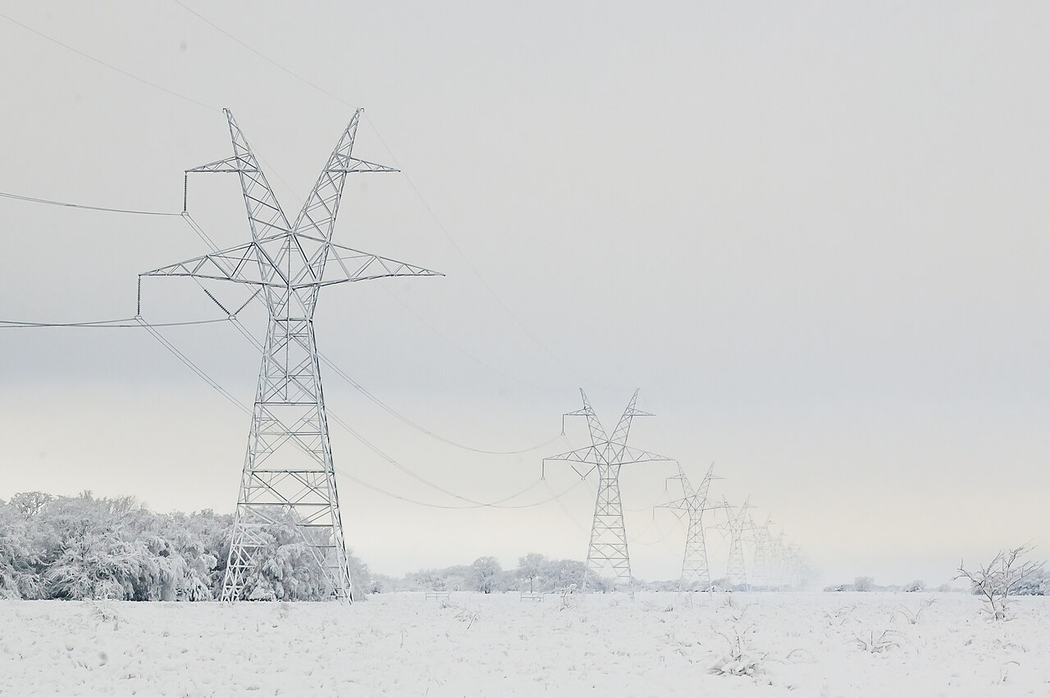
Transmission towers and power lines in snow in East Texas
Transmission lines in snow in East Texas, photographed before 2021. Photo: Matthew T Rader, CC BY-SA 4.0

The phrase "not under FERC" needs one correction. FERC does not regulate ERCOT's wholesale prices, but since the Energy Policy Act of 2005 it has had jurisdiction over grid reliability, through mandatory NERC standards enforced by regional entities such as the Texas Reliability Entity (1). That is why FERC and NERC staff, not only Texas agencies, wrote the definitive report on Uri (1).

Inside that island Texas chose an energy-only market. ERCOT "does not operate a capacity market or impose resource adequacy targets," the UT report explains; instead "market price offer caps have been raised to relatively high levels" so that scarcity prices pay for new plants (9). The cap rose "almost 10-fold over a span of 13 years to $9,000/MWh," and an Operating Reserve Demand Curve, first implemented in 2014, adds to prices automatically as reserves shrink (9). In the market monitor's words, ERCOT "relies heavily on high real-time prices during shortage conditions to provide key economic signals for the development of new resources" (4).

The cold had been tried before. In February 2011 ERCOT shed 4,000 MW of load, affecting some 3.2 million customers (16). The FERC and NERC staffs who investigated looked back to a 1989 freeze and wrote that the Public Utility Commission of Texas (PUCT)'s recommendations then "were not mandatory, and over the course of time implementation lapsed. Many of the generators that experienced outages in 1989 failed again in 2011" (16). The 2011 Legislature responded with a law requiring the PUCT to report on generator weatherization; the UT team found that by mid-2021 only one such report, in 2012, had been filed, and that it "could not verify whether ERCOT generators implemented those recommendations" (9).

ERCOT's chief executive, Bill Magness, put the result plainly to his board nine days after the outages began. "Generation owners and operators are not required to implement any minimum weatherization standard or perform an exhaustive review of cold weather vulnerability," his slide said. "No entity, including the PUC or ERCOT, has rules to enforce compliance with weatherization plans or enforce minimum weatherization standards" (17). ERCOT performed spot checks at about 80 power plant units a year (17).

The planning numbers had the same blind spot. ERCOT's outlook for winter 2020/21 expected about 74,000 MW of capacity to meet a peak of 57,699 MW (9). Its most extreme winter scenario still underestimated actual demand by about 9,600 MW, or 14 percent (9).

Part 02
2021

Nine minutes from dark

ERCOT control room

Demand set a winter record on Sunday night; by 1:51 a.m. on Monday the grid was on a countdown.

In short
  • ERCOT set a winter peak of 69,871 MW at 8 p.m. on February 14 (1).
  • Frequency bottomed at 59.304 Hz at 1:54 a.m.; the famous 4 minutes 37 seconds was the time left on the nine-minute clock (1, 18).
  • Load shed peaked at 20,000 MW and lasted 70.5 hours (1, 17).

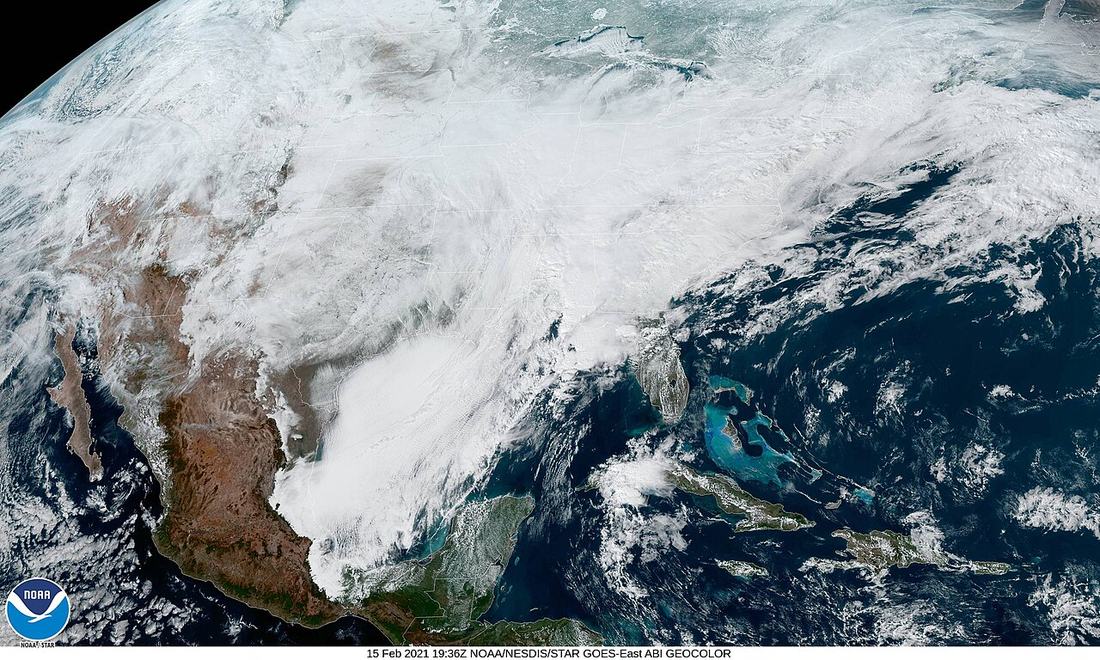
ERCOT and its neighbours knew the cold was coming. ERCOT issued Operating Condition Notices warning generators' scheduling entities and transmission operators of the cold on February 8, and freezing rain and snow began crossing Texas on February 10 (1). Governor Greg Abbott declared a state of disaster for every Texas county on February 12 (10). The forecasts lagged reality. A forecast ERCOT released on February 8 projected 58,728 MW of demand for 8 a.m. on February 15; ERCOT later estimated that demand in that hour would have been 75,573 MW had no customers been cut off (9).

Satellite image of Winter Storm Uri covering Texas and the central United States on February 15, 2021
Winter Storm Uri from the GOES-16 satellite on February 15, 2021. Image: NOAA, public domain

At 8 p.m. on Sunday, February 14, ERCOT set an all-time winter peak of 69,871 MW (1). Temperatures that week dropped as low as six degrees in Austin, eight in Dallas and ten in Houston (1). Overnight, plants dropped off in waves. ERCOT declared the first level of Energy Emergency Alert at 12:15 a.m. on February 15, the second at 1:07 a.m., and the third, which allows controlled outages, at 1:20 a.m. (9).

The FERC-NERC report reconstructs the next half hour minute by minute. Between 1:44 and 1:49 a.m. five more generators tripped or ran back to zero, totalling 1,712 MW (1). "At 1:51 a.m., frequency fell below the 59.4 Hz generator underfrequency relay trip level, starting the nine-minute time delay on those relays," the report says; had those relays tripped, "approximately 17,000 MW of generation would be outaged, potentially causing a total blackout of the ERCOT BA footprint" (1). Operators ordered another 3,000 MW of load shed at 1:50 a.m. and 3,500 MW more at 1:55 a.m. (1). Frequency reached its lowest point, 59.304 Hz, at 1:54 a.m., when physical responsive capability, the grid's last cushion, stood at 1,044 MW (1). At 1:55 a.m. it rose to 59.401 Hz "after remaining below 59.400 Hz for four minutes and 23 seconds" (1).

That is where the widely quoted "4 minutes and 37 seconds" comes from: it is the time that remained on the nine-minute clock, not the time spent below the line (18). Magness told his board why the clock mattered: "if we have a blackout of the system, the system is out for an indeterminate amount of time. We may still be here today talking about when is the power going to come back on ..." (18). The FERC-NERC report concluded that "the grid was within minutes of a much more serious and potentially complete blackout" (1). A restart would not have been simple: the UT team notes the losses already included "some black start units that would have been needed to jump-start the grid" (9).

Rotating outages, the "rolling blackouts" Texans were promised, stopped rotating. Firm load shed peaked at 20,000 MW by 7 p.m. on February 15 (1). At the worst point 52,277 MW, about 48.6 percent of ERCOT's installed capacity, was forced out (17). ERCOT cancelled its last controlled-outage orders at 12:42 a.m. on Thursday, February 18, and returned to normal operations at about 10:35 a.m. on Friday, February 19 (17). Load shed lasted 70.5 hours in all (17, 19), and the grid spent about 105 hours in the highest emergency level (9). Had no one been cut off, ERCOT estimated, demand would have reached 76,819 MW (17, 4).

Part 03
2021

Every fuel failed, gas failed most

Permian Basin and power plants across Texas

Frozen plants and frozen wells fed each other, and controlled outages cut power to the gas system the power plants needed.

In short
  • By count, 58 percent of the units that failed were gas-fired and 27 percent wind (1).
  • Gas production across Texas, Oklahoma and Louisiana fell by more than half at the February 17 low (1).
  • 67 meters in the gas supply chain were enrolled in a programme that cut their power in emergencies (9).

Across Texas and the South Central states, 1,045 generating units suffered 4,124 outages, derates or failures to start between February 8 and 20 (1). By count they were 58 percent natural gas-fired, 27 percent wind, six percent coal, two percent solar, seven percent other fuels and less than one percent nuclear (1). Freezing caused 44.2 percent of the problems and fuel issues 31.4 percent, and natural gas supply caused 87 percent of the fuel problems (1). ERCOT averaged 34,000 MW of generation unavailable for more than two days, "equivalent to nearly half of its all-time winter peak electric load" (1).

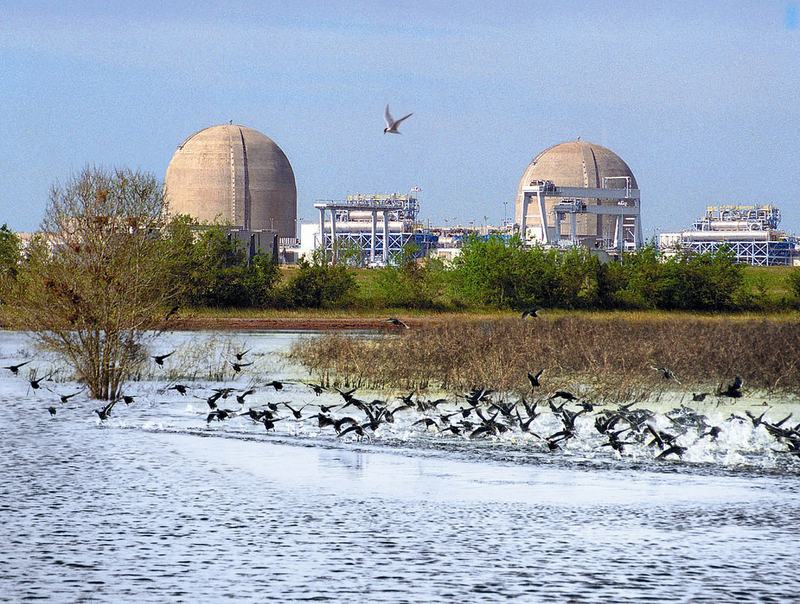
The UT report shows how fast it happened. From noon on February 14 to noon on February 15, offline gas capacity in ERCOT rose from 12,000 MW to 25,000 MW, wind from 14,600 MW to 18,300 MW, coal from 1,500 MW to 4,500 MW, nuclear from zero to 1,300 MW and solar from 500 MW to 1,100 MW (9). The nuclear loss was South Texas Project Unit 1, which tripped at 5:26 a.m. on February 15 "due to low steam generator levels" after losing two feedwater pumps, according to its report to the Nuclear Regulatory Commission (20). It stayed off for about 64 hours (9).

The South Texas Project nuclear plant near Bay City, Texas
The South Texas Project, whose Unit 1 tripped at 5:26 a.m. on February 15. Photo: U.S. Nuclear Regulatory Commission, public domain

The plants were not prepared for conditions they had been warned about. Despite repeated FERC and NERC recommendations, 26 ERCOT units still had no winterization plan, and 81 percent of freeze-related outages across the region happened at temperatures above the unit's own stated design minimum (1).

Gas failed in parallel, and its trouble started first. The EIA describes freeze-offs as what happens "when water and other liquids in natural gas wells freeze at the wellhead or in natural gas gathering lines and block the flow" (21). Texas production fell by more than 10 Bcf/d between February 8 and 17, and U.S. output in February showed "the largest monthly decline on record" (21). Across Texas, Oklahoma and Louisiana, production at its February 17 low was down an estimated 21 Bcf/d, more than half of January's average (1). The UT team found gas already being curtailed to some customers, including power plants, "days before ERCOT called for blackouts" (9).

Then the loop closed. Load shed plans spare hospitals and other critical loads, but "most of the natural gas production and processing facilities the Team surveyed were not identified as critical load or otherwise protected from manual load shedding," the FERC-NERC report found (1). Worse, the UT team found 67 meters that were both in the generator fuel supply chain and enrolled in ERCOT's Emergency Response Service, a programme that would cut their power in an emergency (9). The Dallas Fed counted 38 of Texas' 176 gas processing plants shut down, said the bigger disruption began "when power was cut to the wells, processing plants and compressor stations," and called the result "a death spiral for electricity generation" (19).

Wind failed too, as ice built up on turbine blades (19). Governor Abbott told Fox News that losses in wind and solar "thrust Texas into a situation where it was lacking power in a statewide basis" (22). An ERCOT official said on February 16 that 16 GW of mostly wind generation was offline, against 30 GW of thermal generation (22). Nameplate numbers also overstate wind's share, because grid planners expect only a fraction of it in winter; the FERC-NERC report's example is a 100 MW wind farm counted as 20 MW (1). Measured against the wind actually blowing, the UT team found wind outages fell over the critical 24 hours, from 9,070 MW to 5,020 MW (9). The fair reading: every fuel failed, wind underperformed, and gas plants and their fuel supply accounted for most of the lost megawatts.

Part 04
2021-2025

Dark, cold and without water

Houston, Austin and 77 counties

The official count is 246 deaths. Independent estimates run several times higher.

In short
  • More than 14 million people were told to boil their water (1).
  • 246 confirmed deaths; estimates run from over 200 to over 800 (2, 23).
  • The Dallas Fed put economic losses at $80 billion to $130 billion (19).

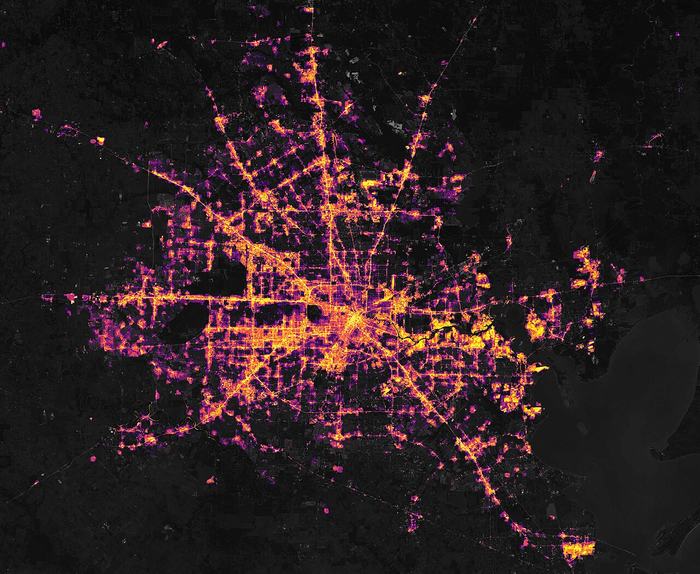
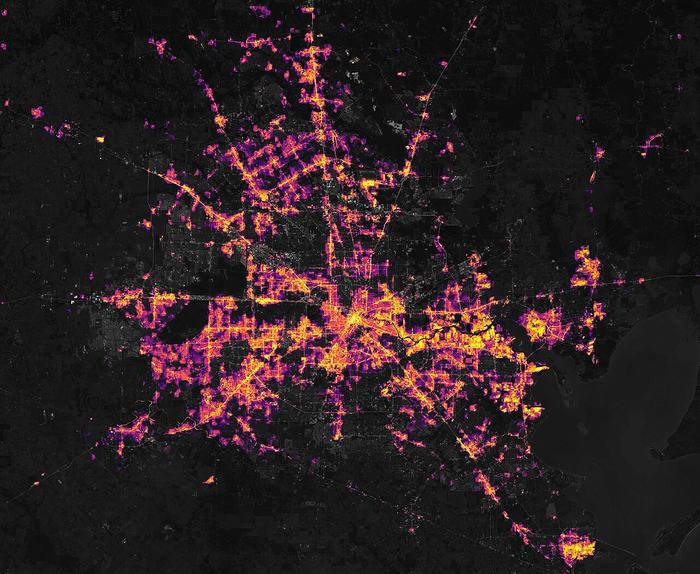
How many lost power depends on what is being counted. The FERC-NERC report says "more than 4.5 million people in Texas lost power" (1). The UT report counts about 4.5 million customers, meaning meters at homes and businesses (9). The Dallas Fed counts nearly 4 million customers, which it says represented more than 11 million people (19). Some went without power for as long as four days while exposed to below-freezing temperatures for more than six (1).

Houston at night on February 7, 2021, with the city fully litHouston at night on February 16, 2021, with large areas dark during the blackout
Houston at night on February 7 (left) and February 16, 2021 (right), during the blackouts. Images: NASA Earth Observatory, public domain

Water failed with the power. In cities including Austin, Houston and San Antonio, more than 14 million people were ordered to boil their drinking water because of broken pipes and lost pressure (1). After Denton lost its gas supply, the FERC-NERC report records, the city "was forced to cut power to nursing homes and water pumping stations" (1).

The death count grew for months. In mid-March the Texas Tribune reported 57 deaths from the state health department's preliminary data (24). In late May the state tally stood at 151, according to BuzzFeed News (3). The FERC-NERC report used a figure of at least 210 (1). The Department of State Health Services' final report, dated December 31, 2021, confirmed 246 deaths across 77 counties, counting only deaths verified by a medical certifier (2). Of these, 161 were extreme cold exposure injuries, 158 of them hypothermia (2). The dead ranged in age from less than one year to 102 (2).

The federal report describes some of them by circumstance: a mother and her seven-year-old daughter and an 11-year-old boy who died of carbon monoxide poisoning, a 60-year-old disabled man who died of hypothermia, and a grandmother and three children who died in a house fire while trying to keep warm (1).

Excess-death methods give a larger number, and it is an estimate. BuzzFeed News compared CDC mortality data with expected deaths in an analysis "reviewed by three independent experts" and found that "between 426 and 978 more people than expected died in Texas in the week ending February 20 alone," with a best estimate of 702 (3). When FERC and NERC staff looked back at Uri in their 2023 report on Winter Storm Elliott, they wrote that estimates of the dead "range from over 200 to over 800" (23). Peer-reviewed work has added detail since: a 2025 cohort study in JAMA Network Open found that long-stay residents of Texas nursing homes that lost power or water had a 0.13 percent higher mortality rate in the three to five weeks after the storm than residents of homes that did not (25).

The economic toll dwarfed the power bills. Dallas Fed economists estimated the freeze and outage could cost the Texas economy $80 billion to $130 billion in direct and indirect losses, while warning that the early figures "come with significant uncertainty" (19). They put insured losses at $10 billion to $20 billion (19). A separate Dallas Fed study found that Gulf Coast refiners, a region where Texas holds nearly a third of U.S. capacity, cut crude processing to a weekly low of 3.9 million barrels a day from 7.8 million the month before, a drop comparable to Hurricanes Ike and Harvey (26).

Part 05
2021-2024

The $9,000 order

Austin

Regulators decided a market cutting off customers must price at the cap. The fight was over when to stop.

In short
  • The PUCT ordered prices to the $9,000 cap while customer load was being shed (10).
  • The market monitor said the intervention ran too long: $16 billion over-priced, a net settlement effect of $3.2 billion (5).
  • The Texas Supreme Court upheld the orders on June 14, 2024 (27).

By February 15 ERCOT's prices had a problem. With more than 10,000 MW of customer load cut off, the pricing software treated the load that had been cut off as if it were not there, and prices across the system had cleared "as low as approximately $1,200" (10, 9). The PUCT's three commissioners signed an order that day. "If customer load is being shed, scarcity is at its maximum, and the market price for the energy needed to serve that load should also be at its highest," it said, directing ERCOT to count shed load in its scarcity pricing (10). The signature page reads "the 15 day of February 2020," a typo in a document that moved billions of dollars (10).

The same order suspended a consumer protection. Once generator revenues pass a threshold called the peaker net margin, then $315,000 per MW-year, the cap is meant to fall to a low cap, the greater of $2,000/MWh or 50 times a gas price index (10). With gas at hundreds of dollars, the PUCT warned, that formula "may exceed the high system-wide offer cap (HCAP) of $9,000 per MWh," so it kept the $9,000 cap (10). The UT team calculated that the low cap would have been $15,359/MWh on February 18 and that, without the suspension, the week's energy costs would have been about $5.2 billion higher (9). A second order on February 16 dropped the instruction to reprice earlier intervals (9, 27).

ERCOT complied "by manually plugging a value" into its pricing model, a change that stayed in place until the grid returned to normal operations on February 19, the Texas Supreme Court later recounted (27). Over 2021, prices sat at or near the $9,000 cap in intervals totalling roughly 98 hours (4). Ancillary services cleared even higher, up to $25,674 per MW for responsive reserve (9). The market monitor put the total value of electricity during the event at $59 billion (4).

The monitor, Potomac Economics, argued the intervention ran too long. ERCOT recalled its last load shed instruction at 23:55 on February 17, so the pricing intervention "should have ended immediately at that time," it wrote; instead ERCOT held prices at $9,000 through the morning of February 19 (5). "This decision resulted over-priced energy in ERCOT's real-time market by $16 billion," the monitor wrote, adding that correcting it "will not reduce costs to consumers by $16 billion" because much demand was served by owned generation or forward contracts (5). It estimated the net settlement effect at $3.2 billion for real-time energy, and $5.1 billion in total with its other proposed corrections (5).

The PUCT's chair, Arthur D'Andrea, said publicly that reversing the charges would be improper or even illegal (28). The Senate passed Senate Bill 2142, which would have forced ERCOT to claw back about $4.2 billion (28). House Speaker Dade Phelan called repricing "an extraordinary government intervention into the free market" and said of the pricing decisions, "I believe that these decisions saved lives"; Lt. Gov. Dan Patrick told senators, "The House stood for big business" (28). On March 16, hours after Texas Monthly reported that D'Andrea had told investors on a call he would throw "the weight of the commission" behind stopping repricing, Governor Abbott announced his resignation (24). The prices were never reversed; the Legislature chose to finance the costs instead (27).

The courts settled the legality three years later. A state appeals court had held that the orders exceeded the PUCT's authority; on June 14, 2024 the Texas Supreme Court reversed and rendered "judgment affirming the orders" (27).

Part 06
2021-2022

Who paid and who got paid

Waco, Houston and the trading floors

A co-op went bankrupt, a wholesale-price retailer folded, and pipeline owners reported windfalls.

In short
  • ERCOT's claim against Brazos Electric was $1,886,595,737.08 (7).
  • Vistra ended 2021 with a net loss of $1,264 million (29).
  • Gas reached $400/MMBtu at Houston Ship Channel and averaged $1,192 at the OGT hub in Oklahoma (30, 31).

ERCOT stands between buyers and sellers in its markets, so defaults spread to everyone. ERCOT reported short payments of about $2.9 billion in April 2021, raised to $2.99 billion in May, and $1.86 billion of that was owed by Brazos Electric Power Cooperative (9). The market monitor later put the total above $3 billion (4).

Brazos describes itself as Texas' oldest and largest generation and transmission cooperative, serving 16 member co-ops that serve more than 1.5 million Texans (6). It filed for Chapter 11 on March 1, 2021, saying ERCOT had presented "excessively high invoices" for collateral and power, "payment of which was required within days," and that it "cannot and will not foist this catastrophic financial event on its members" (6). ERCOT's claim was $1,886,595,737.08 (7). Without collateral ERCOT drew before the filing, the shortfall would have been about $2.25 billion; Brazos argued that more than $1.1 billion of the claim came from the pricing orders, and acknowledged at trial that it owed about $762 million (11). After mediation, the settlement provided for repaying ERCOT $599.7 million of congestion revenue funds it had used to cover the hole, and offered other market participants either about 65 percent over 12 years or 100 percent over 30 years (11, 7). Under ERCOT's default uplift rule, capped at $2.5 million a month, full repayment would have taken about 63 years (7). The plan was confirmed on November 14, 2022 (32).

Retailers that passed wholesale prices straight to households fared worst. Griddy sold wholesale-indexed power for a $9.99 monthly fee and debited customers' accounts automatically; one couple in Willow Park said their bill climbed to nearly $10,000 in a matter of days (33). Griddy filed for Chapter 11 in March 2021. Attorney General Ken Paxton, whose office had sued Griddy under the Deceptive Trade Practices Act, said its bankruptcy plan would release about 24,000 former customers from $29.1 million in unpaid bills (34). Just Energy sought creditor protection in Canada and under Chapter 15 in Houston on March 9, 2021, after it could not pay its ERCOT invoices (35). Other retailers lost their certificates and their customers were moved to new providers (9).

Generators that could not run had to buy at the cap to cover their sales. Vistra said fuel supply problems meant it "had to procure power in the ERCOT market at prices at or near the price cap," and estimated a one-time loss of about $900 million to $1.3 billion (36). It ended 2021 with a net loss of $1,264 million, $1,888 million below 2020, "driven primarily by the impacts of Winter Storm Uri" (29). San Antonio's CPS Energy reported losses of $675 million to $850 million on natural gas purchases (9).

Those with gas to deliver did well. Gas at the Houston Ship Channel set an all-time record of $400/MMBtu on February 16, against about $4.50 a week earlier (30). The OGT hub on ONEOK Gas Transportation's Oklahoma pipeline system averaged $1,192/MMBtu on February 17, "what might be the highest natural gas price at any natural gas hub in history," the EIA wrote, citing NGI data (31). Kinder Morgan's first-quarter net income was $1,409 million against a loss a year earlier, increases "primarily related to the February winter storm" (12). Its chief executive credited "enhanced weatherization at storage and other facilities" and backup generation at critical facilities (12). Energy Transfer said it expected "a total impact of approximately $2.4 billion from the storm" and raised its 2021 outlook (13). Macquarie told the Australian exchange that North American weather had "significantly increased short-term client demand" for its gas and power supply, and that it now expected its year's result to be up about 5 to 10 percent (14).

Part 07
2021-2024

Firing, financing and fixing

Austin

Every PUCT commissioner left, the Legislature made winterization law, and Texans began paying for Uri over decades.

In short
  • ERCOT's board gave its chief executive notice, and every PUCT commissioner left (37, 24).
  • Senate Bill 3 made weatherization law, with penalties of up to $1 million per violation (38).
  • The Texas Energy Fund offers 3 percent loans for new dispatchable plants (39).

The people at the top went first. Seven ERCOT board members resigned after criticism that many did not live in Texas (37). On March 3, 2021 the board voted to give chief executive Bill Magness a 60-day termination notice after more than three hours in closed session (37). PUCT chair DeAnn Walker resigned at the start of March and commissioner Shelly Botkin a week later (24). On March 16 Governor Abbott announced that he had asked for and accepted the resignation of Arthur D'Andrea, the only remaining commissioner (24).

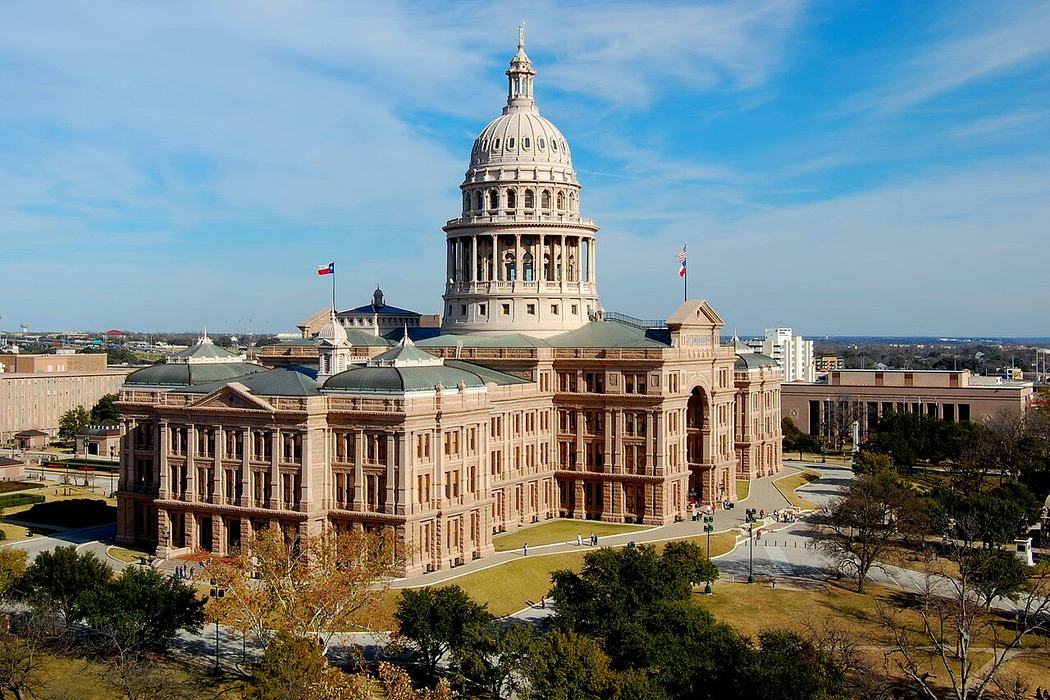
The Texas State Capitol in Austin
The Texas State Capitol, where the 2021 Legislature rewrote ERCOT’s governance and made winterization law. Photo: LoneStarMike, CC BY 3.0

The Legislature passed its two main responses, signed on June 8, 2021 (40, 38). Senate Bill 2 rewrote ERCOT's governance and required "that every member of the governing body be a resident of this state" (40). Senate Bill 3 told the PUCT to require power generators in ERCOT to prepare their plants "to provide adequate electric generation service during a weather emergency," with penalties of up to $1,000,000 for a violation, each day counting separately (38). It told the Railroad Commission to write weather rules for gas supply chain facilities, and the PUCT and the Railroad Commission to create a process to designate natural gas facilities "as critical during energy emergencies" (38).

The PUCT adopted its weather emergency preparedness rule, 16 TAC 25.55, on October 19, 2021, and added summer standards on September 29, 2022 (41). That first winter ERCOT and its contractors inspected 302 generation resources and 22 transmission substations and found potential deficiencies at ten resources totalling 2,129 MW (42).

The debts were refinanced. House Bill 4492, signed on June 16, 2021, let the state comptroller invest up to $800 million from the Economic Stabilization Fund, for up to 30 years, to finance the defaults owed to ERCOT (43). It also authorized financing of up to $2.1 billion that had been uplifted to load-serving entities for reliability deployment price adders and for ancillary services costs above the $9,000 cap (43). Both deals closed, the first in November 2021 and the second on June 15, 2022, repaid through charges on market participants (44, 45). Vistra alone expected $544 million from the securitization (29). Gas customers got their own version: on February 8, 2022 the Railroad Commission approved a financing order for about $3.4 billion of extraordinary gas costs, so that utilities could spread them over monthly bills for more than 4 million residential customers (46).

Market design shifted toward paying for firm capacity. In 2023 the Legislature passed the Powering Texas Forward Act, creating the Texas Energy Fund: 3 percent loans of up to 60 percent of the cost of new or expanded dispatchable plants of at least 100 MW, and completion grants of up to $120,000 per MW for plants connected before June 1, 2026 (39). By August 2025 the loan programme had approved two plants totalling 578 MW, tapping $321 million of the $7.2 billion available (47). The PUCT's broader redesign, the performance credit mechanism, did not survive. After lawmakers capped its cost at $1 billion, ERCOT and the market monitor estimated it would add only about 780 MW against the 10,000 MW needed to meet the state's new reliability standard, and in December 2024 the commission shelved it (48).

The courts closed one more door. In June 2023 the Texas Supreme Court held, five justices to four, that ERCOT is entitled to sovereign immunity, and affirmed the dismissal of CPS Energy's claims against it over the storm (15).

Part 08
2022-2026

Uri’s long shadow

ERCOT

Two later storms tested the fixes. The next stress test is the load, not the cold.

In short
  • During Winter Storm Elliott, ERCOT's reserves never fell below 4,052 MW (49).
  • By March 2026 about 410 GW of large loads were seeking to connect, about 87 percent data centers (50).
  • Senate Bill 6 requires new large loads to be curtailable during firm load shed (8).

The first test came in December 2022. During Winter Storm Elliott ERCOT set a new peak, and its operating reserves "never fell below 4,052 MW," well above the 2,300 MW at which it declares an emergency (49). Of 255 resources inspected beforehand, four had weather-related outages (49). ERCOT noted that temperatures were colder than when it entered emergency on February 15, 2021, and concluded that winterization "likely" had "a positive impact" (49). Its first report gave the peak as 74,100 MW; ERCOT later cited 74,525 MW (49, 51). The same storm forced more than 5,400 MW of rotating outages in the southeastern United States, outside ERCOT (23).

Winter Storm Heather, in January 2024, was the second test. ERCOT set a winter peak of 78,138 MW on January 16 and said this was "the first winter with the full weatherization rule in effect" (51). Thermal forced outages ran at about 7,000 MW, compared with about 14,000 MW during Elliott (51). Gas remained a weak link: curtailments in North Texas cost a net 1,700 MW (51).

Neither storm was Uri. Among winter storms of the past 15 years only Uri lasted longer than Heather, ERCOT said (51), and during Uri, ERCOT says, Texas experienced freezing temperatures for more than 100 consecutive hours (41). The evidence shows a fleet that is better prepared; it does not yet show the grid could ride through a repeat of February 2021.

The bigger change is demand. Had all load been served during Uri, ERCOT's peak would have been 76,819 MW (4). By March 2026 ERCOT was tracking about 410 GW of large loads seeking to connect, about 87 percent of them data centers, up 178 GW since the end of 2025 (50); by late July, ERCOT testimony put the queue at 474 GW, about 90 percent data centers (52). In August 2026 Governor Abbott ordered an audit of every data center in the queue, citing the record peak ERCOT set on July 22, 2026 (52); ERCOT's preliminary figure for that hour is 91,134 MW (53).

Uri is written into the rules those loads now face. Senate Bill 6, signed on June 20, 2025, directs the PUCT to apply large-load interconnection standards above 75 MW, or a lower threshold if needed, and a study fee of at least $100,000 (8). For transmission-voltage loads connected after December 31, 2025, utilities must have a protocol, including any needed equipment, "to allow the load to be curtailed during firm load shed" (8). ERCOT may also direct large loads with backup generation to switch to it or curtail during an emergency, and must count that "as firm load shed when calculating any price adjustments for reliability deployments" (8). In our reading, that sentence writes into statute the principle the PUCT improvised on February 15, 2021 (10). And the curtailment rule exempts facilities designated as critical natural gas facilities, the kind of load that rotating outages cut in 2021 (8, 1).

For anyone selling power or sites in Texas, that is Uri's legacy: a grid that now plans for the cold, prices scarcity by statute, and expects its biggest new customers to be curtailed when the grid runs short.

Frequently asked

What happened during Winter Storm Uri?

In February 2021 an Arctic front pushed Texas demand to a winter record while power plants of every fuel type failed. ERCOT ordered what federal investigators called the largest controlled firm load shed event in US history. More than 4.5 million people in Texas lost power, some for as long as four days, and the state confirmed 246 deaths.

How many people died in Winter Storm Uri?

The Texas Department of State Health Services confirmed 246 deaths in 77 counties, 161 of them from extreme cold exposure. An excess-death analysis by BuzzFeed News estimated about 702 deaths in the week ending February 20, 2021 alone, and a 2023 FERC-NERC report gave a range of over 200 to over 800.

How close did Texas come to a total blackout?

Within about four and a half minutes. At 1:51 a.m. on February 15, 2021, grid frequency fell below 59.4 Hz, starting a nine-minute delay on relays that would have tripped about 17,000 MW of generation and could have blacked out the whole ERCOT system. Operators shed more load and frequency recovered after four minutes and 23 seconds, with 4 minutes and 37 seconds left on that clock.

Did wind or natural gas cause the Texas blackout?

Every fuel failed. By count, 58 percent of the generating units that failed or were derated were gas-fired and 27 percent were wind, and natural gas supply problems caused 87 percent of the fuel issues. Wind underperformed, but planners expect little wind in winter, so its nameplate losses overstate its role.

Why were Texas power prices $9,000 during Uri?

On February 15, 2021 the Public Utility Commission of Texas ordered ERCOT to set prices at the $9,000/MWh cap while customer load was being shed. Over 2021 as a whole, prices sat at or near the cap for roughly 98 hours. ERCOT's independent market monitor said holding the price after load shed ended over-priced real-time energy by $16 billion, with a net settlement effect of $3.2 billion.

What happened to Brazos Electric and Griddy?

Brazos Electric Power Cooperative filed for Chapter 11 on March 1, 2021 after ERCOT bills it could not pay; ERCOT's claim was about $1.89 billion, and its plan was confirmed in November 2022. Griddy, which passed wholesale prices straight to customers and left one couple with a bill of nearly $10,000, also filed for bankruptcy; its plan released about 24,000 former customers from $29.1 million in unpaid bills.

Did Texas fix its grid after Winter Storm Uri?

Partly. Senate Bill 3 made weatherization mandatory. During Winter Storm Elliott in 2022 ERCOT's reserves never fell below 4,052 MW, and thermal forced outages during Winter Storm Heather in 2024 were about half of Elliott's. Neither storm lasted as long as Uri.

How does Winter Storm Uri affect data centers in Texas?

Senate Bill 6, signed in June 2025, requires new large loads connected at transmission voltage after 2025 to be curtailable during firm load shed, and lets ERCOT direct large loads with backup generation to switch to it in an emergency. By March 2026 about 410 GW of large loads were seeking to connect to ERCOT, about 87 percent of them data centers.

Sell into ERCOT’s next decade

After Uri, every co-op, retailer, generator and data center developer in Texas is rethinking how it buys, backs up and curtails power. EnergyLeads gives energy sellers verified contacts at ERCOT utilities, co-ops, retailers, power traders and large loads, researched to your brief.

Get 5 free sample contacts See the US energy email list

Watch and listen

10 recordings and records

Broadcaster and agency clips first; independent channels are labelled. The dates are the years the clips were published, where known.

PreviewTitleSourceDateChapterAbout
Why the Texas power grid failedPBS NewsHour202102 Nine minutes from darkA broadcaster explainer on the blackouts.
What really happened during the Texas power grid outage?Practical Engineering202102 Nine minutes from darkAn engineer explains grid frequency and load shed; an independent channel.
Texas power outages: how the state's grid failed under pressureThe Washington Post202103 Every fuel failed, gas failed mostA visual account of how the grid failed.
Failures in coal, natural gas added to Texas power outage: White HouseReuters202103 Every fuel failed, gas failed mostWire-service clip from the early fight over blame.
Panel discussion on the Texas blackout of February 2021INFORMS202105 The $9,000 orderOperations researchers on the market and operating lessons.
Legislators hear from ERCOT and power company executivesKVUE (Austin)202107 Firing, financing and fixingThe Texas legislative hearing with ERCOT and power company executives.
A year ago, Texas power plants weren't required to winterize. Now they areWFAA202207 Firing, financing and fixingThe weatherization story a year on.
ERCOT can't be sued over 2021 winter storm, Texas Supreme Court rulesWFAA202307 Firing, financing and fixingReport on the 2023 sovereign immunity ruling.
Texas power grid catastrophe: what went wrong and what's changed since 2021CBS Austin08 Uri's long shadowA local retrospective.
JUICE (Episode 1): Texas BlackoutJUICE (independent documentary series)08 Uri's long shadowEpisode of an independent documentary series, not a broadcaster.

Further reading

11 books
TitleAuthorYearPublisherTopicWhy read it
Report on Outages and Curtailments During the Southwest Cold Weather Event of February 1-5, 2011Causes and RecommendationsStaffs of FERC and NERC2011Federal Energy Regulatory CommissionOfficial reportsThe warning Texas received a decade earlier.
The February 2021 Cold Weather Outages in Texas and the South Central United StatesFERC, NERC and Regional Entity Staff2021Federal Energy Regulatory Commission and North American Electric Reliability CorporationOfficial reportsThe definitive federal reconstruction, with the minute-by-minute frequency record.
The Timeline and Events of the February 2021 Texas Electric Grid BlackoutsCarey W. King, Josh D. Rhodes, Jay Zarnikau et al.2021The University of Texas at Austin Energy InstituteOfficial reportsThe best single account of the market and financial side, with a history of the ERCOT market.
2021 State of the Market Report for the ERCOT Electricity MarketsPotomac Economics2022Independent Market Monitor for ERCOTOfficial reportsThe monitor's numbers on Uri prices, shortage hours and defaults.
Power LossThe Origins of Deregulation and Restructuring in the American Electric Utility SystemRichard F. Hirsh1999MIT PressMarket designThe history behind restructuring.
Power System EconomicsDesigning Markets for ElectricitySteven Stoft2002IEEE Press and Wiley-InterscienceMarket designThe standard text on scarcity pricing and the energy-only versus capacity debate.
Making Competition Work in ElectricitySally Hunt2002WileyMarket designA practitioner's guide to the market design choices Texas made.
Electricity RestructuringThe Texas StoryL. Lynne Kiesling and Andrew N. Kleit (eds.)2009AEI PressMarket designHow Texas built its competitive wholesale and retail markets.
Brittle PowerEnergy Strategy for National SecurityAmory B. Lovins and L. Hunter Lovins1982Brick House PublishingThe gridThe classic warning about cascading failures in centralised energy systems.
The GridThe Fraying Wires Between Americans and Our Energy FutureGretchen Bakke2016Bloomsbury USAThe gridA readable account of how the U.S.
A Question of PowerElectricity and the Wealth of NationsRobert Bryce2020PublicAffairsThe gridA journalist's case for cheap, reliable electricity as the basis of prosperity.

References

53 sources
  1. FERC, NERC and Regional Entity Staff, "The February 2021 Cold Weather Outages in Texas and the South Central United States," Federal Energy Regulatory Commission and North American Electric Reliability Corporation, 2021-11-16, nerc.com. ↩
  2. Texas Department of State Health Services, Disaster Mortality Surveillance Unit, "February 2021 Winter Storm-Related Deaths - Texas," Texas DSHS, 2021-12-31, dshs.texas.gov. ↩
  3. Peter Aldhous, Stephanie M. Lee and Zahra Hirji, "Texas's Winter Storm Killed Hundreds More Than Reported," BuzzFeed News, 2021-05-26, buzzfeednews.com. ↩
  4. Potomac Economics (Independent Market Monitor for ERCOT), "2021 State of the Market Report for the ERCOT Electricity Markets," Potomac Economics, 2022-05, potomaceconomics.com. ↩
  5. Potomac Economics (Independent Market Monitor), "Letter to PUCT Chairman Arthur C. D'Andrea re PUC Project No. 51812, Issues Related to the State of Disaster for the February 2021 Winter Weather Event," PUCT Interchange (Project 51812, item 149), 2021-03-11, interchange.puc.texas.gov. ↩
  6. Kathleen Witte (with the full Brazos Electric news release), "Brazos Electric files for bankruptcy after winter storm, 'cannot and will not' pass ERCOT prices to consumers," KBTX, 2021-03-01, kbtx.com. ↩
  7. Chief Financial Officer of ERCOT (declarant), "Declaration in Support of ERCOT Settlement, In re Brazos Electric Power Cooperative, Inc., Case No. 21-30725 (DRJ), Document 2488," U.S. Bankruptcy Court, Southern District of Texas (copy hosted by ERCOT), 2022-11-10, ercot.com. ↩
  8. Texas Legislature, 89th Regular Session, "S.B. No. 6 (enrolled), relating to the planning for, interconnection and operation of, and costs related to providing service for certain electrical loads," Texas Legislature Online, 2025-06-20, capitol.texas.gov. ↩
  9. Carey W. King, Josh D. Rhodes, Jay Zarnikau et al. (committee of faculty and staff), "The Timeline and Events of the February 2021 Texas Electric Grid Blackouts," The University of Texas at Austin Energy Institute, 2021-07-13, energy.utexas.edu. ↩
  10. Public Utility Commission of Texas (DeAnn T. Walker, Arthur C. D'Andrea, Shelly Botkin), "Order Directing ERCOT to Take Action and Granting Exception to Commission Rules, Project No. 51617," PUCT Interchange, 2021-02-15, interchange.puc.texas.gov. ↩
  11. Chad V. Seely, Vice President and General Counsel, ERCOT, "Letter to the PUCT re Brazos Electric Power Cooperative, Inc. v. ERCOT, ERCOT Settlement Update (Projects 52933 and 52937)," ERCOT, 2022-11-02, ercot.com. ↩
  12. Kinder Morgan, Inc., "Kinder Morgan Increases Dividend 3 Percent and Raises 2021 Guidance," Kinder Morgan, Inc. (investor relations), 2021-04-21, ir.kindermorgan.com. ↩
  13. Energy Transfer LP, "Energy Transfer Reports First Quarter 2021 Results (Exhibit 99.1 to Form 8-K)," U.S. Securities and Exchange Commission (EDGAR), 2021-05-06, sec.gov. Archived copy. ↩
  14. Macquarie Group Limited, "Macquarie Group provides update to short-term outlook (ASX/Media Release)," Macquarie Group, 2021-02-22, macquarie.com. ↩
  15. Supreme Court of Texas (Hecht, C.J.), "CPS Energy v. Electric Reliability Council of Texas, No. 22-0056, consolidated with ERCOT v. Panda Power Generation Infrastructure Fund, No. 22-0196," Supreme Court of Texas, 2023-06-23, search.txcourts.gov. ↩
  16. Staffs of the Federal Energy Regulatory Commission and the North American Electric Reliability Corporation, "Report on Outages and Curtailments During the Southwest Cold Weather Event of February 1-5, 2011: Causes and Recommendations," Federal Energy Regulatory Commission, 2011-08, ferc.gov. ↩
  17. Bill Magness, ERCOT, "Review of February 2021 Extreme Cold Weather Event, ERCOT Presentation (Item 2.2, revised)," ERCOT Urgent Board of Directors Meeting, 2021-02-24, ercot.com. ↩
  18. Matt Largey, "Texas' Power Grid Was 4 Minutes And 37 Seconds Away From Collapsing. Here's How It Happened.," KUT 90.5, 2021-02-24, kut.org. ↩
  19. Garrett Golding, Anil Kumar and Karel Mertens, "Cost of Texas' 2021 Deep Freeze Justifies Weatherization," Federal Reserve Bank of Dallas, Dallas Fed Economics, 2021-04-15, dallasfed.org. ↩
  20. U.S. Nuclear Regulatory Commission, "Event Notification Report for February 15, 2021 (South Texas Project Unit 1, automatic reactor trip)," U.S. NRC, 2021-02-15, nrc.gov. Archived copy. ↩
  21. Mike Kopalek and Emily Geary (principal contributors), "February 2021 weather triggers largest monthly decline in U.S. natural gas production," U.S. Energy Information Administration, Today in Energy, 2021-05-10, eia.gov. ↩
  22. Bryan Mena, "Gov. Greg Abbott and other Republicans blamed green energy for Texas' power woes. But the state runs on fossil fuels.," The Texas Tribune, 2021-02-17, texastribune.org. ↩
  23. FERC, NERC and Regional Entity Staff, "Inquiry into Bulk-Power System Operations During December 2022 Winter Storm Elliott," Federal Energy Regulatory Commission and North American Electric Reliability Corporation, 2023-10, ferc.gov. ↩
  24. Cassandra Pollock and Shawn Mulcahy, "Texas' last Public Utility Commission member resigns at Gov. Greg Abbott's request," The Texas Tribune, 2021-03-16, texastribune.org. ↩
  25. Brian Downer, Alexandra Holland, Shuang Li and Huiwen Xu, "Winter Storm Uri, Mortality, and Health Care Use of Nursing Home Residents," JAMA Network Open 8(4): e254111, 2025-04-08, doi.org. DOI: 10.1001/jamanetworkopen.2025.4111. Abstract. ↩
  26. Jesse Thompson, "Texas Winter Deep Freeze Broke Refining, Petrochemical Supply Chains," Federal Reserve Bank of Dallas, Southwest Economy, 2021 (Second Quarter issue; no day printed), dallasfed.org. ↩
  27. Supreme Court of Texas (Hecht, C.J.), "Public Utility Commission of Texas v. Luminant Energy Company LLC, No. 23-0231," Supreme Court of Texas, 2024-06-14, search.txcourts.gov. ↩
  28. Shawn Mulcahy, Cassandra Pollock and Patrick Svitek, "Electricity repricing bill hits wall in House, marking first major schism with Senate this session," The Texas Tribune, 2021-03-16, texastribune.org. ↩
  29. Vistra Corp., "Vistra Reports 2021 Results and Reaffirms 2022 Guidance," Vistra Corp., 2022-02-25, investor.vistracorp.com. ↩
  30. U.S. Energy Information Administration, "Natural Gas Weekly Update (release of February 18, 2021)," U.S. Energy Information Administration, 2021-02-18, eia.gov. ↩
  31. Stephen York (principal contributor), "Cold weather brings near record-high natural gas spot prices," U.S. Energy Information Administration, Today in Energy, 2021-03-05, eia.gov. ↩
  32. Norton Rose Fulbright, "US restructuring team successfully represents Brazos Electric Power Cooperative, Inc. in its Chapter 11 case," Norton Rose Fulbright (law firm press release), 2023-01, nortonrosefulbright.com. ↩
  33. Minyvonne Burke, "$29 million of electric bills from Texas winter storm will be forgiven, AG says," NBC News, 2021-03-17, nbcnews.com. ↩
  34. Office of the Attorney General of Texas, "AG Paxton Ensures Forgiveness of $29 Million in Electric Bills for 24,000 Texans After Suing Griddy Energy, LLC," Office of the Attorney General of Texas, 2021-03-16, texasattorneygeneral.gov. ↩
  35. Just Energy Group Inc., "Management's discussion and analysis, June 25, 2021 (Exhibit 99.2 to SEC filing 0001104659-21-085979)," U.S. Securities and Exchange Commission (EDGAR), 2021-06-25, sec.gov. Archived copy. ↩
  36. Vistra Corp., "Vistra Reports 2020 Results Above Top End of Raised Guidance Range and Estimates One-Time Impact of Winter Storm Uri," Vistra Corp. (PR Newswire), 2021-02-26, investor.vistracorp.com. ↩
  37. Erin Douglas and Mitchell Ferman, "CEO of Texas power grid operator terminated in aftermath of winter storm," The Texas Tribune, 2021-03-03, texastribune.org. ↩
  38. Texas Legislature, 87th Regular Session, "S.B. No. 3 (enrolled), relating to preparing for, preventing, and responding to weather emergencies and power outages," Texas Legislature Online, 2021-06-08, capitol.texas.gov. ↩
  39. Texas Legislature, 88th Regular Session, "S.B. No. 2627 (enrolled), the Powering Texas Forward Act," Texas Legislature Online, 2023-06-09, capitol.texas.gov. ↩
  40. Texas Legislature, 87th Regular Session, "S.B. No. 2 (enrolled), relating to the governance of the Public Utility Commission of Texas, the Office of Public Utility Counsel, and an independent organization certified to manage a power region," Texas Legislature Online, 2021-06-08, capitol.texas.gov. ↩
  41. ERCOT, "ERCOT Trending Topics: Weatherization," ERCOT, 2026-04-02, ercot.com. ↩
  42. ERCOT, "ERCOT Final Report on Winter Weather Readiness Inspections, PUC Projects 52786 and 52787," PUCT filing (copy hosted by ERCOT), 2022-01-17, ercot.com. ↩
  43. Texas Legislature, 87th Regular Session, "H.B. No. 4492 (enrolled), relating to financing certain costs associated with electric markets," Texas Legislature Online, 2021-06-16, capitol.texas.gov. ↩
  44. ERCOT, "Subchapter M Default Balance Securitization," ERCOT, 2026-10-04 (accessed), ercot.com. ↩
  45. ERCOT, "Subchapter N Uplift Balance Securitization," ERCOT, 2026-10-04 (accessed), ercot.com. ↩
  46. Railroad Commission of Texas, "RRC's Commissioners Approve Financing Order to Keep Monthly Gas Utility Bills Low," Railroad Commission of Texas, 2022-02-08, rrc.texas.gov. ↩
  47. Paul Cobler, "Texas' $7.2 billion loan program for gas power plants has approved two projects in two years," The Texas Tribune, 2025-08-26, texastribune.org. ↩
  48. Kayla Guo (The Texas Tribune, republished by KSAT), "Texas regulators shelve an electricity market reform proposal they say does too little to shore up grid," The Texas Tribune via KSAT, 2024-12-19, ksat.com. ↩
  49. ERCOT, "December 2022 ERCOT Cold Weather Operations Report (Public): Winter Storm Elliott Public Report, Version 1.0," ERCOT, 2023-03-27, ercot.com. ↩
  50. Jeff Billo, ERCOT Vice President, Interconnection and Grid Analysis, "Item 9: Interconnection and Grid Analysis Update," ERCOT Board of Directors Meeting, April 20-21, 2026, 2026-04-13, ercot.com. ↩
  51. ERCOT, "ERCOT Monthly, January 2024 (Winter Storm Heather recap)," ERCOT, 2024-01-31, ercot.com. ↩
  52. Sonal C. Patel, "Abbott Orders Full Audit of Texas Data Center Interconnection Queue, Threatens to Deny Grid Access," POWER Magazine, 2026-08-04, powermag.com. ↩
  53. ERCOT, "ERCOT Monthly Operational Overview (July 2026)," Electric Reliability Council of Texas, 2026-08-17, ercot.com. ↩

Image credits

Storm over Texas: NOAA GOES-16, public domain. Houston at night before and during the blackout: NASA Earth Observatory (Black Marble), public domain. South Texas Project: U.S. Nuclear Regulatory Commission, public domain. Transmission lines in snow: Matthew T Rader, CC BY-SA 4.0 (photographed before 2021). Texas State Capitol: LoneStarMike, CC BY 3.0. Video previews: YouTube.